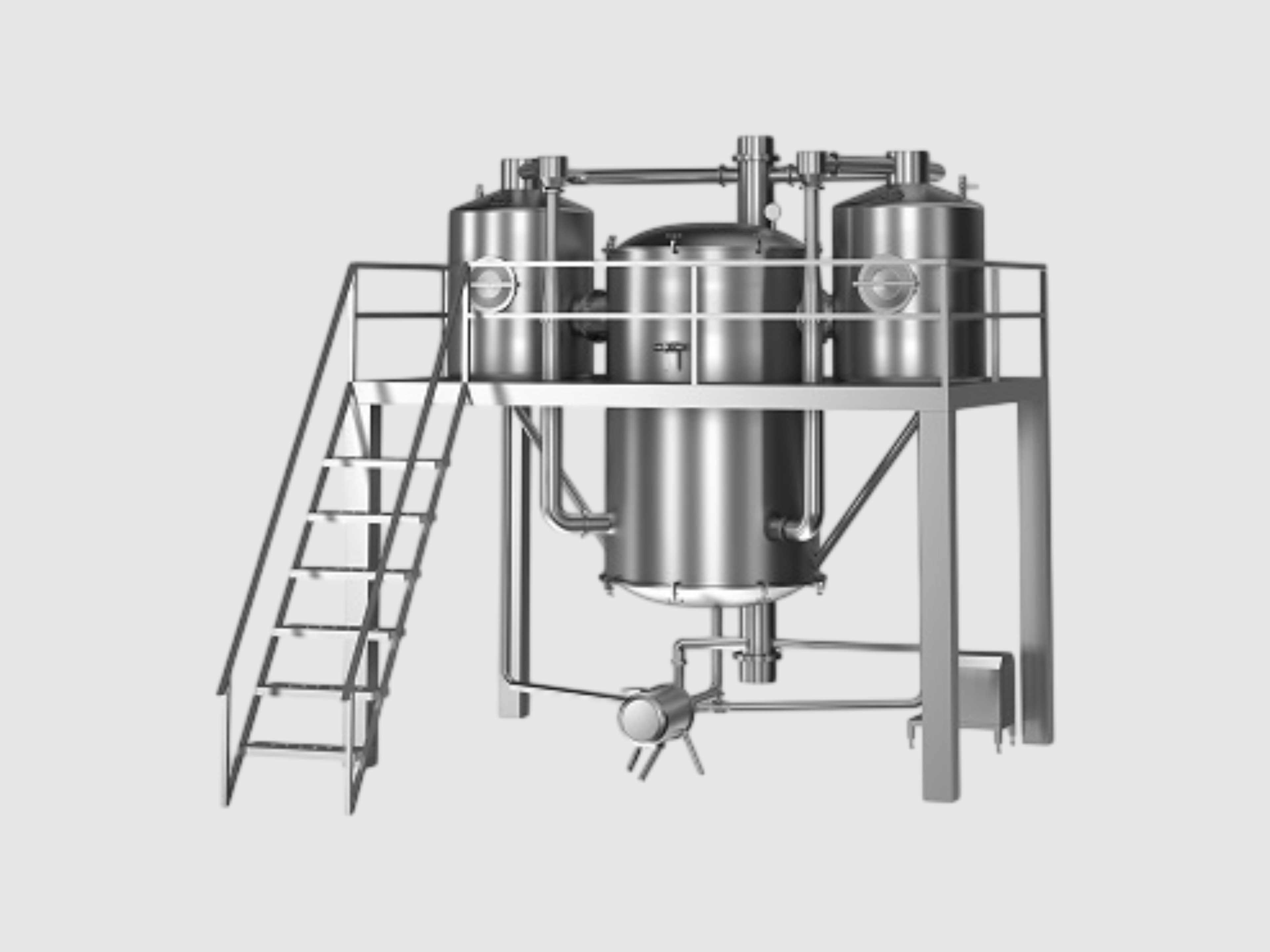
Overview
The Vacuum Evaporator is a specialized concentration unit used in yogurt production to remove a controlled portion of water from milk before fermentation, resulting in a higher total-solids content. This produces a thicker, creamier yogurt with elevated protein and caloric value without the need for milk powder addition, meeting the growing consumer demand for Greek-style and high-protein yogurt. Pre-heated milk is fed into an evaporation chamber maintained under vacuum (typically 0.6–0.8 bar below atmospheric pressure). The reduced pressure lowers the boiling point of water to 55–65 °C, allowing evaporation to occur at temperatures that do not damage heat-sensitive proteins or vitamins. The evaporated water vapor is drawn off by a vacuum pump and condensed in a barometric condenser. The concentrated milk — with total solids increased by 15–30% — exits the evaporator and proceeds to pasteurization and fermentation.
Working Principle
Pre-heated milk is fed into an evaporation chamber maintained under vacuum (0.6–0.8 bar below atmospheric pressure). The reduced pressure lowers the boiling point of water to 55–65 °C, allowing evaporation to occur at temperatures that preserve heat-sensitive proteins and vitamins. The evaporated water vapor is drawn off by a vacuum pump and condensed in a barometric condenser. The concentrated milk exits the evaporator with total solids increased by 15–30% and proceeds to pasteurization and fermentation. The process is continuous and fully automated, with the concentration ratio controlled by adjusting feed rate and vacuum level. An automatic foam-detection and anti-foam dosing system maintains process stability. An energy-efficient vapor recompression option is available to reduce steam consumption.
Applications
The Vacuum Evaporator is used in Greek yogurt, high-protein yogurt, concentrated ayran, pre-concentration of milk for labneh, and infant formula production. It is also used in milk powder manufacturing, whey concentration, and lactose crystallization processes.